Funexpected Math: from
0 to award-winning global early-math product
An app for non-readers ages 3–7 to build core math skills, reasoning, and problem-solving in a beautiful and challenging game environment.
Product
Company
Role
Co-founder & Creative Lead from day 1
Task
Create a universal tool that helps children around the world overcome math anxiety, and become math literate before school gaps appear.
Results
1M+ installs worldwide
Families play Funexpected in 175 countries and 15 languages.
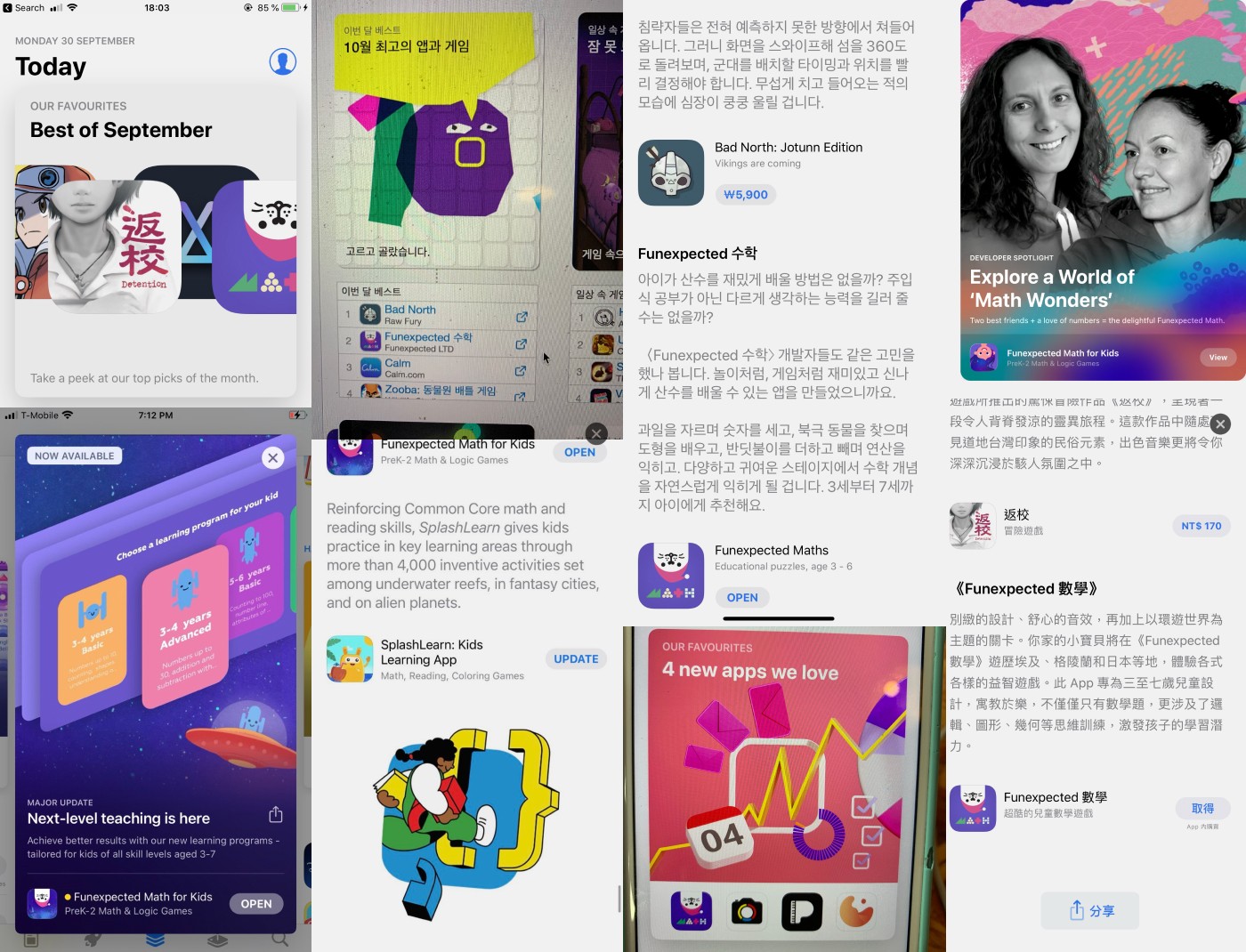
Featured by the App Store in 30+ countries
Continuously featured by Apple in different markets since launch.
Pre-installed on new iPads in Apple Retail Stores globally
Since 2024, a demo version of Funexpected is available on new iPads in Apple Stores around the world.
Winner of multiple international awards for design and learning
Including the WEBBY Award for Best visual design in games, KIDSCREEN Award for Best Learning app — original, and EdTech Breakthrough Award for Best math learning solution.
Efficacy supported by independent research
Funexpected was selected as one of four math apps for a University of Chicago RCT, which showed that children ages 4–5 from low-income families who played math apps progressed in math 3× faster compared to traditional schooling.
About
Team
I co-founded Funexpected with an old high-school friend and helped build the team from the ground up, hiring across product, design, marketing, and curriculum.
Challenge
We wanted to create a space where children could learn math naturally, almost like a new language: through stories, talking to characters, through exploration, mistakes, surprises, and play. The product had to solve three problems at once:
First, it had to be fully accessible to non-reading children, because ages 3–7 are the most important years for building early mathematical intuition.
Second, it had to adapt to very different children: different ages, skills, languages, attention spans, confidence levels, and interests — while keeping each child in their zone of proximal development.
Third, it had to work for families regardless of parents’ math background. The app needed to be self-paced, self-explanatory, and easy to enter, so that high-quality early math support would not depend on having a mathematically confident adult nearby.
As children learn to read through books, not spelling drills, we wanted to create a similar world for math: a rich, beautiful environment where children could enter, explore, and gradually acquire the language of mathematical thinking and problem-solving.

Launch
Soft launch
We wanted to release the MVP as quickly as possible, so we could test the product with real families and improve it through live use.
So we decided to start with a soft launch in two smaller markets before going worldwide. We did not compromise on content or design quality: from the beginning, I wanted Funexpected to feel exceptional. Instead, we limited the amount of content while making sure all core product systems were already in place.
The goal was to learn how to build and scale the product effectively before global launch.

Decision 1. Build adaptive gameplay and generative level of challenge from the start
Why: personalization and adaptability were meant to be core product values.
I used the first three games to develop and test our approach to game design. Instead of creating pre-designed levels and tasks, I designed a system that generated difficulty dynamically based on each child’s behavior. Each game used multiple variables that directly affected the level of challenge and could be adjusted independently for every child.
This helped us find the right level of challenge for each child, while avoiding the need to build a huge amount of content manually. Because the tasks kept changing within the same familiar game setting, the experience felt less repetitive and more engaging.
The result was a more personalized user experience and a more efficient, scalable production process.


Decision 2. Make math part of a world children could explore
Why: we wanted children to experience math as part of culture and everyday life, not as a set of isolated exercises.
From the MVP stage, each math topic lived inside a distinct country, story, and visual world. Exploration was not decoration around the learning experience; it was part of the product itself.
This helped position math as a way to understand the world and made curiosity a core part of the experience.
Decision 3. Launch in 15 languages from the start
Why: global scale had to be built into the product architecture, not added later.
During the soft launch, the Apple team noticed the product even though it was available in only two countries. Their interest reinforced our decision to build Funexpected for a global audience from the beginning.
We created the infrastructure for storing and managing localization, then built a translation workflow across 15 languages with translators, editors, and independent quality checks.
This required more work upfront, but made international scaling significantly faster.
Result
Within six months of the global launch, Funexpected was featured by the App Store in more than 30 countries, including Japan, South Korea, and China — markets with particularly strong interest in early math education.

Growth
Growing retention and conversion
We used a bucket-based growth model, grouping users by activity and subscription status. From launch, Funexpected followed a freemium model: families could access one game for free and unlock the full library with a subscription.
Because young children are usually not allowed to use learning apps every day, our main engagement metric was WAU, not DAU.
At this stage, we focused on free users with the potential to move into the paid bucket and paid users at risk of dropping out. For the first group, the goal was conversion. For the second, it was retention and bringing them back to active use.
Decision 4. Create a recurring loop with short missions
Why: free users needed a way to discover the content they were missing, while paying users needed reminders of content they had not explored or had forgotten about.
I proposed adding short, five-minute missions on top of the existing game library. Missions introduced children to games they had not tried before, including content that was normally unavailable in the free version.
Because the feature reused existing games rather than requiring new content, we were able to launch it in 2 months.
Result: conversion to paid rose by 8.4%, and annual plans grew to four times their previous share of all subscriptions.
Decision 5. Introduce a talking digital tutor, multiple learning programs, and varied formats
Why: we needed to improve both learning outcomes, helping children learn more in a single session, and retention, by creating a stronger reason for families to choose a year-long subscription.
I developed the concept and led the creation of a talking digital tutor that assessed children at the start, built a program around their level and needs, and guided them through it with scaffolding, feedback, and encouragement when tasks became difficult.
Because the tutor had to work across all 15 existing languages, scalability and production efficiency were built into the system from the beginning.
We also expanded the learning experience with new formats and brought them together into structured year-long programs: skill practice, numeracy drills, assessments, oral questions, and hands-on lessons guided by the tutor and supported by offline materials.
This variety was especially important for younger children with shorter attention spans. Switching between formats helped them stay focused, reduced repetition, and allowed them to complete more meaningful work in each session.


Decision 6. Redesign the experience of the first two sessions
Why: the first two sessions strongly shaped future behavior and were a good predictor of conversion to trial.
User interviews, analysis of user flows, and onboarding A/B tests showed us that the first two sessions played a crucial role in predicting future conversion. The first session was usually completed by a parent exploring the product alone. The second was often completed together with the child to see whether they enjoyed it.
I led a full redesign of both sessions around these behaviors. We rebuilt the parent-facing part of the app and structured the first session so that even a quick exploration would give parents the right mental model of the product and clearly communicate its key value.
The work was iterative. After each round of testing, we studied how users understood the product and adjusted the experience accordingly. This led us to split the learning journey into age-based programs and introduce an initial assessment that placed each child into the right program based on their age and level.
Result: Day 28 retention reached the 75th percentile among comparable apps in the App Store.

Photo © Nadia Shilo
Marketing
Connecting marketing with the product
We had exceptionally strong feedback from families already using Funexpected. But analysis of the marketing funnel showed that installing the app and completing onboarding required a meaningful investment of time. Until parents experienced the product themselves, it was difficult for them to understand what made it different.
We needed shorter experiences that could communicate the value of Funexpected outside the main product, while also giving existing users a reason to come back more often.
Decision 7. Turn seasonal events into a product and marketing loop
Why: we wanted to re-engage existing families and give new users an easy way to experience the product.
We created limited-time in-app events connected to the marketing calendar. Each event was a small themed experience that taught mathematics while introducing children to the history and culture behind a celebration.
Together with well-known seasonal events such as Halloween, Thanksgiving, Christmas, Chinese New Year, Back-to-school, etc. we introduced celebrations from different cultures, including Hanami, Hanukkah, Līgo, etc. to help children discover cultures from all around the world.
Each event included shareable achievements that families could post outside the app. This connected the product experience back to acquisition and closed the loop between engagement and marketing.
Result: seasonal events brought us ~100K new unique impressions in App Store.
Results
From zero to global scale, with 2.5M math tasks solved each month and international recognition for design and learning, including Webby, Kidscreen, and EdTech Breakthrough.
01
1M+ installs worldwide, 2.5M+ math tasks solved monthly
Families play Funexpected Math in 175 countries and 15 languages.
02
Featured by the App Store in 30+ countries
Continuously featured by Apple in different markets since launch.
03
Pre-installed on new iPads in Apple Retail Stores globally
Since 2024, a demo version of Funexpected is available on new iPads in Apple Stores around the world.
04
Multiple international awards for design and learning
Winner of multiple international awards for design and learning, including the WEBBY Award for Best Visual Design in Games, KIDSCREEN Award for Best Learning App, and EdTech Breakthrough Award for Best Math Learning Solution.
05
Efficacy supported by independent research
Funexpected Math was selected as one of four math apps for a University of Chicago RCT, which showed that children ages 4–5 from low-income families who played math apps progressed in math 3× faster compared to traditional schooling.
